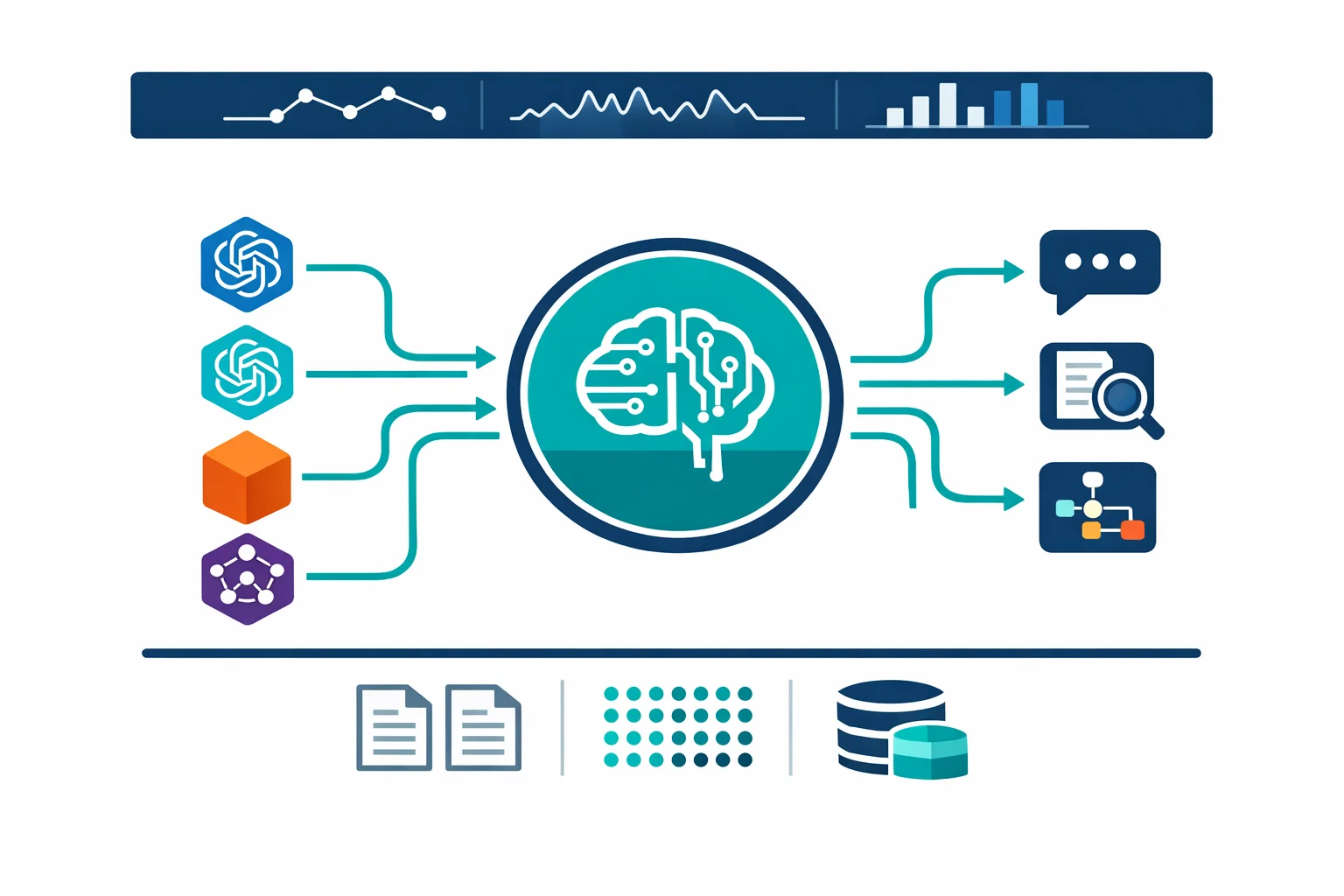
APIM as an AI Gateway in 2026: Where It Helps
In this article
- What APIM’s AI Gateway Actually Is
- Problem 1: One Application Consumes Everyone’s Quota
- Problem 2: The Model Key Has Spread Into Every Application
- Problem 3: Capacity Is Fragmented Across Deployments and Regions
- Problem 4: Nobody Can Attribute Consumption
- Problem 5: Agents Need Governed Access to Tools
- Where This Leaves Us

AI Gateway series: Part 1: Where It Helps (this article) · Part 2: Where It Does Not Help
In short: API Management’s AI gateway has grown into a credible policy-enforcement layer for shared LLM traffic: token limits per consumer, token metrics with custom dimensions, model backend pools with session-aware routing, and MCP governance. It earns its place the moment AI consumption becomes a shared platform concern: several teams, several backends, budgets someone has to allocate. This first part covers the five enterprise problems it genuinely solves. Part 2 covers what it does not solve, the features to use carefully, and four architecture patterns to choose between.
The first AI application rarely needs a gateway. It has one development team, one model deployment, and a token budget small enough to inspect manually.
The gateway discussion starts later. A second team wants access to the same deployment. Finance asks which application consumed the quota. Security wants the API keys out of the config files. The primary deployment starts returning 429s at month end. Someone proposes a second region, and nobody agrees whether failover belongs in the application or in the platform.
Say the organisation now runs three AI workloads: an HR assistant, an internal coding tool, and a customer-service summariser, all sharing model capacity. This is where API Management can earn its place. It is also where teams begin asking it to solve problems that do not belong in a gateway. In the Foundry upgrade decision we looked at the resource layer under your AI workloads; this series is about the layer in front of them, and part 2 will conclude that some workloads should skip it entirely. That conclusion is what makes the recommendations below worth anything.
What APIM’s AI Gateway Actually Is
Microsoft originally delivered the AI gateway as a set of capabilities inside the API Management gateway you may already run, and that model continues across the established APIM tiers: if an existing instance has the right tier, network path, and spare capacity, adoption is mostly a configuration exercise, though extra AI traffic can still mean extra gateway capacity and feature availability varies by tier. Since 23 July 2026 there is also a dedicated AI Gateway tier in public preview: a separate managed resource with a portal-card policy experience, gateway-scoped runtime keys, and for now two regions, no SLA, and unannounced pricing. This series focuses on the established APIM implementation, which remains the production option for most enterprise environments today.
Applications and agents
          |
        APIM
          |
Foundry models / Azure OpenAI / external models / MCP servers
APIM remains an HTTP gateway. What changed is that it now understands AI traffic: token-based limits and quotas, LLM-aware usage metrics, model backend pools with circuit breakers, semantic caching, Azure AI Content Safety integration, streamlined Foundry model imports, MCP and agent API governance, and a preview unified model API that exposes multiple providers through one OpenAI-compatible endpoint. It handles the OpenAI Chat Completions and Responses schemas, the Anthropic Messages API (v2 tiers), and Google Vertex, wherever the backing model runs.
Feature lists are Microsoft’s job, and theirs is good. The useful question is which problems each feature genuinely solves.
Problem 1: One Application Consumes Everyone’s Quota
A model deployment’s TPM limit protects the deployment. It does nothing to allocate capacity fairly between the applications sharing it, and a plain request limit treats the summariser’s 20,000-token document analysis the same as the HR assistant’s 200-token classification call. Token limits do not.
The llm-token-limit policy enforces a TPM limit or a token quota per hour, day, week, month, or year, keyed on whatever identifies a consumer. It can pre-estimate prompt tokens and refuse a request before the backend ever sees it:
<llm-token-limit
    counter-key="@(context.Request.Headers.GetValueOrDefault(
        "x-application-id", "unidentified"))"
    tokens-per-minute="20000"
    estimate-prompt-tokens="true" />
The counter key is the actual governance decision, and it deserves more thought than the limit value. Limiting by APIM subscription works only when subscriptions map cleanly to applications or cost owners; a shared subscription key gives you centralisation without attribution. And a header like x-application-id must derive from a trusted identity or a validated token claim, because an unverified header is a quota any consumer can rewrite in one line of code.
Problem 2: The Model Key Has Spread Into Every Application
A healthier identity chain looks like this:
Application identity (Entra)
          |
APIM authorises the consumer
          |
APIM managed identity
          |
Foundry / Azure OpenAI
Hiding the key is the smallest part of the benefit. The chain separates three decisions that a shared API key collapses into one: who may call the platform, what that consumer may call, and how the gateway authenticates to the backend. APIM supports managed identity toward Azure AI services and OAuth flows for clients, agents, and MCP servers through its credential manager.
One caveat that belongs in any enterprise design: APIM subscription keys are useful product identifiers, but they are not a workload identity strategy. They normally sit behind Entra authentication rather than replacing it.
Problem 3: Capacity Is Fragmented Across Deployments and Regions
Every platform team knows the progression. One application calls one deployment directly. Capacity tightens. More deployments appear across resources and regions. Every application grows its own retry and fallback logic, the behaviours diverge, and the next incident takes a day to diagnose because no two consumers fail the same way.
APIM backend pools centralise that logic: round-robin, weighted, priority-based, and session-aware distribution, with a circuit breaker that reads the backend’s Retry-After header for a precise trip duration. The canonical pattern:
APIM endpoint
  |- Priority 1: PTU deployment, primary region
  |- Priority 2: pay-as-you-go deployment, same region
  |- Priority 3: approved secondary-region deployment
Session-aware balancing can matter for stateful assistants and conversational agents, where requests from one session should stay on the same backend. It works through session affinity and requires the client to retain the APIM session cookie, and Microsoft is initially releasing it through the AI Gateway Early update group, so verify availability before making it part of a production design. Stateless requests do not need the affinity.
Two qualifications keep this honest. Routing is an architecture decision before it is an availability feature: crossing regions or switching model families changes latency, data-location assumptions, model behaviour, and cost, so risk owners define which routes are permitted and APIM merely executes them. And load balancing distributes the quota you already bought; it cannot create capacity. For the specific burst-overflow case, Foundry can now handle it natively: spillover redirects excess traffic from a provisioned deployment to a corresponding standard deployment in the same Foundry resource, without involving the gateway.
Problem 4: Nobody Can Attribute Consumption
For attribution, the llm-emit-token-metric policy emits prompt, completion, and total token counts to Application Insights with dimensions you choose: API, subscription, a user ID, a cost centre. Combined with the built-in token dashboard, it answers the question that arrives a few months after any AI platform goes live: who is spending this, and on what?
Think of the observability offer in three levels, with different defaults:
| Level | What it captures | Sensible default |
|---|---|---|
| Consumption | Model, application, token counts, status | Almost always on |
| Operational | Latency, backend chosen, throttling, failover, correlation IDs | On in production |
| Content | Prompts and completions | Off until a data and retention review says otherwise |
Content logging is the trap. “Turn on AI logging” sounds harmless until the logs contain customer correspondence, employee questions to the HR assistant, retrieved document fragments, and generated decisions, all in a workspace with its own access list and retention. Microsoft keeps prompt and completion logging optional, large messages are split across log entries, and token reporting can be incomplete for interrupted streams. Log token and operational metadata by default, keep content logging off until someone owns the justification, and never present gateway logs as complete AI observability: the application still has to record outcomes, retrieved sources, and evaluation results.
Problem 5: Agents Need Governed Access to Tools
APIM can expose an existing REST API as an MCP server, govern remote MCP servers, and apply authentication, rate limits, and telemetry to agent traffic, including A2A agent APIs. A preview goes further and associates an APIM instance directly with a Foundry resource, so quotas, agents, and tools are governed from the Foundry portal. The portal integration currently requires a v2 APIM instance in the same Entra tenant and subscription as the Foundry resource, with compatible private connectivity where the Foundry resource has public access disabled. The MCP governance path has narrower preview boundaries still: today it covers newly created MCP tools that do not use managed OAuth, so verify the exact traffic path your agents take before you rely on it.
The boundary to respect: the gateway can decide whether an agent may reach a tool endpoint. It cannot decide whether approving a payment, deleting a record, or changing a customer’s status is appropriate in the current business context. Transaction limits, confirmation steps, idempotency, separation of duties, and human approval live inside the tool and the business service behind it.
Where This Leaves Us
Five real problems, five capabilities that address them, and a pattern behind all of them: the gateway helps wherever AI access is a shared platform concern with an identity attached. The signal box authorises, routes, meters, and records.
The signal box can inspect parts of the manifest. What it cannot decide is whether the cargo is correct, authorised, and safe for the business process receiving it. Part 2 covers what APIM does not solve (prompt injection, business authorisation, model quality, private networking), the three attractive features to use carefully, four architecture patterns from direct connection to governed platform, and the decision table that tells you which one you are in.
Technical details verified against Microsoft’s AI gateway and LLM logging documentation on 18 July 2026.
Related: Azure OpenAI to Microsoft Foundry: When to Upgrade and What to Fix First the resource layer under this one · APIM v2 vs Classic tiers and networking for the gateway itself · Enterprise AI on Azure in 2026 the platform-wide view
Planning an enterprise AI gateway?
The fixed-scope Azure AI Platform Architecture Review maps the real model, agent, and tool traffic, defines the identity, quota, routing, and logging model, and identifies which controls belong in APIM, in Foundry, in the application, or in the network.